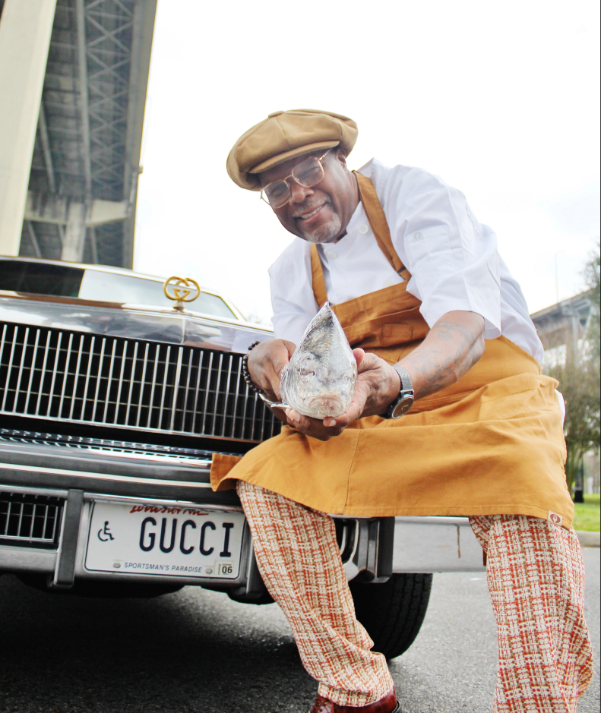
SwagHer has had the pleasure of sharing Chef D’s story before, but some stories are worth revisiting—especially when the person behind them continues to evolve.
A New Orleans native whose culinary journey has taken him from washing dishes to becoming an executive chef, restaurateur, caterer, and culinary ambassador, Chef D has built his career around much more than preparing good food. His Creole, Cajun, and soul food are rooted in the flavors, people, and traditions that raised him. While culinary school strengthened his technique and his professional experiences expanded his knowledge, Chef D credits Southern food with giving him his culinary identity.
Since our last conversation, Chef D has continued expanding his brand through catering, private-chef experiences, pop-ups, food products, community work, and new business ventures. But he has also evolved personally. These days, he is thinking more intentionally about legacy, peace, purpose, and the man underneath the chef coat.
That made his return to SwagHer especially fitting for our Self-Care Issue.
This time, we’re looking beyond what Chef D puts on the plate to explore what happens around it. For him, Southern food is intertwined with memories of home, family, culture, and community. A pot of gumbo or red beans can invite people to slow down. A shared meal can create space for conversation. A familiar flavor can transport someone back to Sunday dinner at Grandma’s house.
In our latest conversation with Chef D, we explore self-care through a different lens—one that makes room for comfort food, cultural traditions, balance, joy, and gathering around the table with the people we love.
Fancy: Southern food is often tied to memories, family, and tradition. What does Southern cuisine represent to you personally, and how has that shaped the chef you are today?
Chef D: Southern cuisine represents home, family, struggle, love, and tradition to me. Growing up in New Orleans, food was never just something we ate; it was how we came together. Some of my greatest culinary lessons didn’t start in a professional kitchen. They came from watching my mother, my uncle, and people in my community cook with what they had and turn simple ingredients into something that brought everybody to the table.
Those memories shaped the chef I am today. As my career took me from washing dishes to becoming an executive chef, restaurateur, caterer, and culinary ambassador, I never forgot where my foundation came from. Culinary school gave me technique, and traveling and working with other culinary professionals expanded my knowledge, but Southern food gave me my identity.
Today, when I prepare Creole, Cajun, or soul food, I’m not just serving a plate; I’m telling a story. I want people to taste New Orleans, feel the culture, and maybe even remember somebody from their own family who used to cook for them.
That’s what Southern cuisine means to me: honoring where I came from while using everything I’ve learned along the journey to carry the tradition forward.
Fancy: This issue is centered on self-care, but we know self-care isn’t always about diets, exercise, or spa days. How do you see food, especially comfort food, playing a role in joy, connection, and emotional well-being?
Chef D: For me, food has always been about more than just feeding the body. Food can feed your spirit, too. Sometimes self-care is sitting down to a plate that reminds you of home, your mother’s kitchen, your grandmother, or a Sunday dinner with family.
Comfort food has a way of bringing back memories and creating connection. A pot of red beans, some gumbo, fried fish, mac and cheese, or a good plate of smothered food can make people slow down, laugh, talk, and forget about the pressures of life for a little while. That’s emotional well-being, too.
As a chef, I’ve seen firsthand how food can change the atmosphere in a room. People may come to the table carrying stress, grief, disappointment, or just the weight of everyday life, but good food brings people together. Conversations start. Stories get told. People laugh. Sometimes healing happens without anybody even realizing it.
I believe self-care is also about giving yourself permission to enjoy life. Everything doesn’t have to be about counting calories or denying yourself something you love. There has to be balance. Sometimes that bowl of gumbo, that piece of bread pudding, or that meal surrounded by people you love is exactly what your spirit needs.
That’s one of the reasons I love being a chef. I’m not just cooking food; I’m creating moments, memories, comfort, and connection. Sometimes, that can be its own form of medicine.
Fancy: There’s something special about gathering around a table with people you love. What do you think we lose when we become too busy to slow down, share a meal, and truly connect with one another?
Chef D: I think when we become too busy to sit down and share a meal, we lose some of the connection that keeps families and communities together. The table has always been more than a place to eat. It’s where we talk, laugh, tell stories, solve problems, celebrate victories, and sometimes work through disagreements.
Growing up, sitting around the table gave you an opportunity to learn things you couldn’t learn from a book. You heard stories from your elders, learned family traditions, and found out what was really going on in each other’s lives. Today, everybody is moving so fast—working, chasing goals, answering phones, and scrolling through social media—that we can be in the same room and still not truly be together.
As a chef, I’ve learned that food has the power to make people slow down. Once that food hits the table, something happens. People start talking. Somebody tells an old story. Somebody starts laughing. For that moment, everything else can wait.
I believe we have to protect those moments. Success is important, and taking care of business is important, but so are the people we’re working so hard for. Sometimes the best form of self-care is simply putting the phone down, pulling up a chair, sharing a good meal, and being present with the people you love.
Fancy: As someone whose work revolves around serving and creating experiences for others, what does self-care look like for you when you’re the one who needs to be poured into?
Chef D: As a chef, I spend a lot of my life pouring into other people. I’m cooking for them, serving them, creating experiences, mentoring young people, taking care of clients, and making sure everybody else is good. But I’ve learned that you can’t keep pouring from an empty pot.
For me, self-care means knowing when I need to step away from being “Chef D” and just be Donald for a little while. Sometimes that means getting some rest, listening to music, praying, spending time with family and people I love, traveling, or simply sitting somewhere quietly without having to cook, answer a phone, solve a problem, or take care of anybody.
I’m still learning that it’s okay to let other people pour into me. When you’re used to being the person everybody depends on, receiving can sometimes be harder than giving. But I’ve realized that I need encouragement, love, support, laughter, and somebody checking on me, too.
Self-care for me is about protecting my peace, giving myself permission to rest, and remembering that Donald needs some of the same love and care that Chef D gives everybody else. If I take care of the man underneath the chef coat, I can continue showing up and giving the best of myself to everyone I serve.
Fancy: Southern cuisine isn’t always associated with traditional ideas of “healthy eating.” How do you think we can enjoy the foods that are part of our culture and bring us joy without feeling guilty about what’s on our plates?
Chef D: I think we have to stop looking at Southern food as something we should feel guilty about. Our food is more than calories; it’s culture, history, family, memories, and love. These are recipes that have been passed down through generations, and there’s nothing wrong with enjoying them.
For me, it’s about balance, portions, and preparation. You don’t have to take the soul out of soul food to make better choices. Maybe you use less salt, choose fresh ingredients, grill or roast something instead of frying it every time, or simply watch your portion size. But I don’t believe you have to completely change Grandma’s recipe just to say you’re eating healthy.
And sometimes, you eat the fried chicken, macaroni and cheese, greens, cornbread, and peach cobbler—and you enjoy it! One meal doesn’t define your health. Food should nourish the body, but it should also nourish the spirit.
As a Southern chef, I believe we can honor where we come from, enjoy the foods that bring us joy, and still be mindful about how we eat. Culture shouldn’t come with guilt. The key is balance, not deprivation.
Fancy: SwagHer has featured your story before, so we’ve had an opportunity to watch your journey evolve. What has changed for you personally and professionally since we last spoke, and how have those experiences influenced the way you approach your craft and business today?
Chef D: Since SwagHer last featured my story, a lot has changed, both personally and professionally. I’ve grown not only as Chef Donald, but as a man, businessman, mentor, and leader in my community. At this stage of my journey, I’m looking beyond just cooking great food. I’m thinking more about legacy, impact, and what I’m leaving behind.
And here’s a little inside joke for the people who’ve really been following my journey: I grew up being called “Lukie,” but the last time SwagHer featured me, I made it clear—I wanted to be called Donald! Well, Donald has definitely done some growing since then. Lukie is still in there somewhere, but Donald had to grow up, handle business, and become more intentional about the man he wanted to be.
Professionally, I’ve continued expanding my brand through catering, private-chef experiences, pop-ups, food products, community work, and new business opportunities. One of my biggest lessons has been realizing that being a great chef and running a great business are two different skills. I’ve become more intentional about knowing my value, protecting my time, building strong relationships, and creating opportunities that can grow beyond me personally being in the kitchen.
Personally, life has taught me to appreciate the journey differently. Family, faith, relationships, losses, wins, and setbacks have all shaped the way I move today. I still hustle, and I still love the kitchen, but I’m learning that success isn’t just about being busy. It’s also about peace, taking care of yourself, and being present for the people who matter.
All of that shows up in my food and in the way I conduct business. I cook with more purpose now. I’m not just putting food on a plate—I’m creating an experience, telling a story, building a legacy, and hopefully inspiring somebody else along the way.
So yes, Lukie grew up, Donald stepped up, and Chef D is still cooking! And the beautiful part is, I’m still learning, still evolving, and still writing the next chapter.
Fancy: When someone sits down to enjoy a meal you’ve prepared, what do you hope they experience beyond simply enjoying good food? What do you want people to feel when they leave your table?
Chef D: When someone sits down at my table, I want them to experience more than just good food. I want them to feel something. I want that first bite to bring back a memory—maybe Sunday dinner at Grandma’s house, a family reunion, a holiday gathering, or simply a moment when life felt good.
For me, food has always been about connection, culture, conversation, and love. I want my table to be a place where people can put the phone down, laugh a little louder, tell stories, and enjoy the people around them. The presentation may be beautiful and the flavors may be elevated, but I never want the experience to lose its soul.
Now that I’m cooking for a much wider range of people through my Airbnb experiences, especially guests who may be visiting New Orleans for the first time, I’ve learned to bring more of myself personally to the table. I’m not just serving them New Orleans food—I’m sharing my New Orleans with them. I’m sharing my journey, my culture, my stories, and some of the history behind the dishes they’re eating.
Sometimes people come to the table as strangers, but by the end of the experience, we’re laughing, talking, and connecting like we’ve known each other for years. That’s the power of food and hospitality.
When you leave my table, I want you full, of course, but I also want you to leave happy, appreciated, connected, and cared for. I want you talking about not only what Chef D cooked, but about the experience and the person you met behind the food.
Because at this point in my journey, I’m not just putting Chef D on the plate. I’m bringing Donald to the table. And that personal connection is what I hope people remember long after the last bite.
Connect With Chef D
X: @chefdrolling
YouTube: chefdonaldsmith
Instagram: @chefdtheking
Facebook: Donald Lukie Smith
Website: www.chefdonaldsmith.com
Photography by Brandon Knox