As Texas expands its investment in film and television production, TIVID TV is working to ensure the next generation is prepared to take part in the opportunities growth can create.
Through Movie Lab™, TIVID TV is introducing students to filmmaking through a hands-on educational model that connects storytelling, science, technology, and professional production practices. The program is designed not only for young people interested in film, but also for parents seeking career-connected opportunities, CTE and education leaders looking for stronger media pathways, and companies interested in supporting the future workforce.
That work comes at a significant moment for Texas’ moving image industry. The state’s Texas Moving Image Industry Incentive Program is designed to attract productions and create Texas jobs, with qualifying film and television projects eligible for incentives of up to 31% of eligible Texas spending. State funding for the program has also grown substantially, with $300 million appropriated for the 2026–2027 biennium. (Texas.gov)
For TIVID TV and its owner Chris and McKenzy Bowers, that investment raises an important question: Who is being prepared for the jobs and opportunities that could follow?
Connecting the Classroom to the Film Industry
Movie Lab™ grew from a gap TIVID’s team saw between learning individual filmmaking skills and understanding how a professional production actually functions.
Traditional film education may teach pre-production, production, post-production, camera, lighting, sound, and editing as separate subjects. TIVID’s approach helps students understand how those areas influence one another.
A camera decision can affect lighting. Sound can alter how an audience experiences a scene. A production choice can create consequences in post-production. Even audience, marketing, and distribution considerations can influence creative decisions before filming begins.
At the center of Movie Lab™ is The Elements of Filmmaking™, a framework developed through Tivid Technologies that uses the organizational logic of the periodic table to help learners see filmmaking as a system of interconnected elements.
Instead of simply being told how a filmmaking technique works, students can experiment with variables such as camera perspective, lighting, sound, and genre and observe how those changes affect the story.
For parents and students, that means Movie Lab™ goes beyond simply teaching someone how to operate a camera.
The program helps young people understand why filmmakers make certain choices and how those choices work together in an actual production environment.
“The most valuable thing we can teach may not be a particular camera, software, or technique. It’s how to think intentionally as a filmmaker,” McKenzy said.
Preparing Students for the Jobs Behind the Screen
Texas’ growing production incentives emphasize Texas-based spending and employment. To qualify for the state’s film and television incentive program, productions generally must complete at least 60% of production in Texas, while at least 35% of paid crew and 35% of paid cast must be Texas residents. (Texas.gov)
For students interested in filmmaking, that makes workforce preparation increasingly relevant.
Movie Lab™ does not focus exclusively on technical skills. Students also learn the professional behaviors that help crews function successfully.
Chris, a filmmaker and business owner, said the industry requires far more than knowing how to use equipment.
“Movie Lab™ has challenged the assumption that technical ability alone prepares someone for the professional industry,” Chris said.
Communication, adaptability, time management, taking direction, understanding crew roles, and problem-solving are among the skills TIVID hopes learners begin developing before they enter their first professional production.
Rather than waiting until someone lands a job to discover what a professional set requires, Movie Lab™ aims to introduce those expectations earlier and gradually increase responsibility as students develop.
A Resource for CTE and Education Leaders
TIVID’s vision also extends beyond an individual class.
Over the next five years, the organization plans to develop adaptable curriculum and instructional supplements that could integrate into existing middle school, high school, Career and Technical Education programs, and eventually college classrooms.
The goal is not to replace existing film and media programs. Instead, TIVID wants to give educators additional tools to connect classroom instruction to practical industry experience.
That could include professional crew structures, production paperwork, set workflows, time management, real-film case studies, audience psychology, marketing, distribution, and emerging technologies such as artificial intelligence.
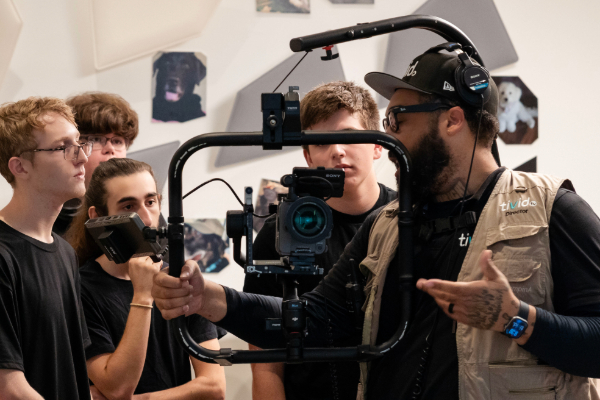
TIVID has already had an early opportunity to connect education with professional production through its work with Leander ISD CTE students. Students were exposed to professional equipment, production documentation, crew structures, workflows, time management, set expectations, and individualized mentorship around an active project.
As Movie Lab™ develops, TIVID envisions a model in which students can move from learning concepts to observing professional productions, experimenting with those concepts themselves, and, when appropriate, eventually contributing under professional mentorship.
Learning Alongside the First Cohort
TIVID is currently working with its first Movie Lab™ youth cohort, giving the organization an opportunity to evaluate the curriculum through real student experiences.
One early lesson has been how much hands-on learning can change things.
Students can manipulate creative variables and immediately see or hear how their choices change the story. Their questions, interests, interpretations, and challenges are also helping the TIVID team determine where the curriculum should evolve.
“The first cohort isn’t only learning from Movie Lab™; Movie Lab™ is learning from its first cohort,” the team explained.
For families, that creates a learning environment where filmmaking becomes something students can explore rather than simply study.
For educators, it offers a model that combines technical education, creative thinking, experimentation, and workforce readiness.
Building an Education-to-Industry Pipeline
Movie Lab™ is also part of a larger educational ecosystem being developed through TIVID.
Advanced and emerging filmmakers, working adults, and educators can continue learning through an online learning management system and pursue the Elements of Cinematic Science™ Certification (ECSC). The pathway explores cinematic psychology, visual storytelling systems, professional production concepts, audience behavior, distribution, marketing, emerging technologies, and the Elements of Filmmaking™.
TIVID ultimately wants to connect that education directly with Tivid TV Studios, creating what the team describes as a living learning environment.
Students could learn concepts through curriculum, experiment through Movie Lab™, continue their development online, and eventually observe those same principles on active professional sets.
The studio environment could expose learners to the realities of client expectations, professional equipment, schedules, deadlines, crew collaboration, and the real-time problem-solving required to deliver a finished production.
An Opportunity for Industry Partners to Help Build What Comes Next
As Texas works to attract more film, television, and moving image productions, workforce development becomes part of the larger conversation.
For companies, production partners, and community-minded sponsors, programs like Movie Lab™ represent an opportunity to support students before they enter the professional workforce.
TIVID’s long-term vision is to move Movie Lab™ from a class to a curriculum, from curriculum to a pathway, and eventually into an environment where education and professional filmmaking operate side by side.
That growth creates potential opportunities for industry partners to support access to education, technology, equipment, experiential learning, and the development of young filmmakers who may one day become part of Texas’ expanding production workforce.
For McKenzy and Chris, the ultimate goal is developing the whole filmmaker.
Technical knowledge matters, but so do story, collaboration, accountability, adaptability, and communication.
McKenzy’s guiding question is whether students understand why something works.
Chris’s is whether they can apply it when it matters.
Movie Lab™ sits at the intersection of both.