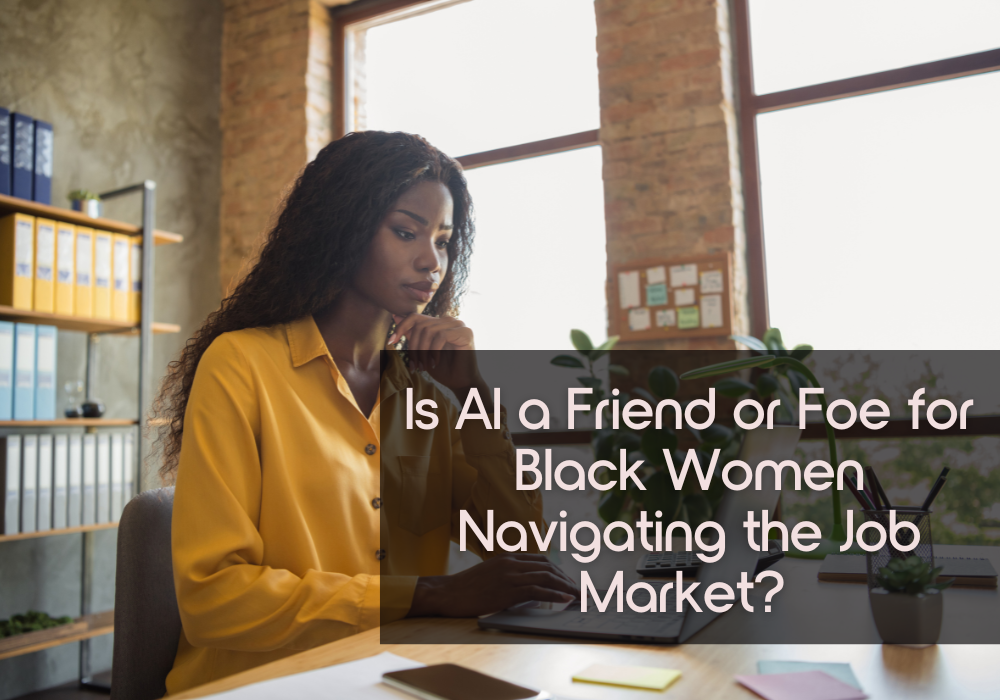
Is AI a friend or foe for Black women navigating the job market? Bias in hiring has always been a concern, but even more so since AI has entered the chat.
Plenty of media outlets have already run with stories on how AI has perpetuated and reinforced biases, but a particularly telling experiment from 2022 is key to understanding the issue.
For it, behavioural economist Martin Abel partnered with fellow economist Rulof Burger to survey 1,500 people from all 50 U.S. states. The pair says the group was nationally representative in terms of race and ethnicity, age, and gender.
In collecting data on participants’ beliefs about the race and ethnicity, education, productivity, and personality traits of people with six names, it uncovered the following:
“We found that the names of workers perceived as Black, such as Shanice or Terell, were more likely to elicit negative presumptions, such as being less educated, productive, trustworthy and reliable, than people with either white-sounding names, such as Melanie or Adam, or racially ambiguous names, such as Krystal or Jackson.”
As they were specifically studying discrimination against Black people, they did not include names in this experiment that are frequently associated with Hispanics or Asians.
Next, participants were presented with pairs of names and asked to select the worker who was more productive in a particular task.
“The chance that they would choose job candidates they perceived to be white because of their names was almost twice as high than if they thought the candidates to be Black. “
There was a greater tendency to discriminate against people with Black-sounding names by men, people over 55, whites, and conservatives.
And unfortunately, when you look into many companies’ C-suites, they often make up some or all of these demographics.
Rush hour
The experiment also found that rushing causes even more discriminatory behavior.
This is very relevant at the moment, as hiring managers are inundated with thousands of AI-assisted applications for jobs, and may have shorter times to review each resume.
When this experiment was conducted, hiring managers were spending less than ten seconds reviewing resumes at the early-screening stage, and to keep pace may have resorted to mental shortcuts, including racial stereotypes, when assessing applications.
Imagine the time pressures on hiring managers now that job seekers are using gen AI to mass apply to advertised roles.
The economists behind this report found that when study participants had two seconds to select a worker, they were 25% more likely to discriminate against candidates with Black-sounding names.
This is where AI can actually help. Advanced AI tools, like Dash, can scan through thousands of applications, ignoring names, addresses, dates of birth, and school/college names, and can specifically only look at skills and experience.
It can then create a shortlist, ranked based on those skills and experience, and how they match up to the job description.
Ultimately, whether AI helps or hinders bias depends on the data set it’s trained on, and how the AI is designed to operate.
With the right training, AI can only concentrate on abilities, credentials, and experience, and can actually assist employers in creating more inclusive and balanced teams.
Predictive hiring
However, training AI to be unbiased is not a one-time only thing.
Because of predictive hiring, where AI becomes more adept at determining a candidate’s potential for success based on existing company data, it can develop its own biases.
Certain artificial intelligence algorithms might observe that candidates who have gone to a specific institution or school, or even belong to a specific country club, typically do well in a company. This may reduce a diverse candidate pool to a narrow one.
Regular audits and monitoring of AI recruiting software are essential.
AI models must be continually trained on diverse data to prevent underrepresentation, and this data should also be scrubbed of particular attributes like names or zip codes that could skew its predictions.
In terms of auditing, hiring professions can track the types of candidates frequently selected and address any emerging gaps by working closely with data scientists and CIOs.
Future of AI hiring
However you feel about AI in recruitment, it’s here to stay.
More than 400 talent acquisition experts globally participated in Korn Ferry’s Talent Acquisition Trends 2025 report, and 67% of them said they thought the use of AI would be a major talent acquisition trend in 2025.
But additionally, a quarter of these professionals say they are worried about algorithmic bias in hiring.
As we move past the evangelistic “AI can do anything” phase, to a more tempered “AI can do specific tasks well with the right direction and data”, it’s positive that combating bias is on so many TA professionals’ agenda.
If you’re thinking about implementing an AI hiring solution into your business, or if you’re applying for a job that uses AI software in the process, ask your account or hiring manager if the tools are designed to mitigate bias, and ask how this is achieved with data sets, and if there’s regular audits.
Inclusive companies are outspoken about their fair hiring practices and their commitment to building diverse and inclusive teams.
And that includes championing the AI recruiting tools they use. If its AI software is trained to focus on skills and experience, and ignores applicant names, gender, age, ethnicity, hobbies or educational institutions, you could be onto a winner.
By Amanda Kavanagh
Ready to get your job search underway? Browse thousands of jobs on SwagHer’s Job Board